

Oxford or Cambridge? It’s a question that’s troubled students, academics and fans of competitive rowing for generations. For visitors to England, however, the rivalry is rather less serious. Both are beautiful historic cities, both contain world-famous universities, and both make excellent additions to a trip beyond London.
They aren’t interchangeable, though. Oxford feels larger and busier, with university buildings set into the map of a substantial city. Cambridge is smaller and greener, and the River Cam gives it a character all its own.
If you only have time for one, your interests should decide which way you go.
Why Visit Oxford?
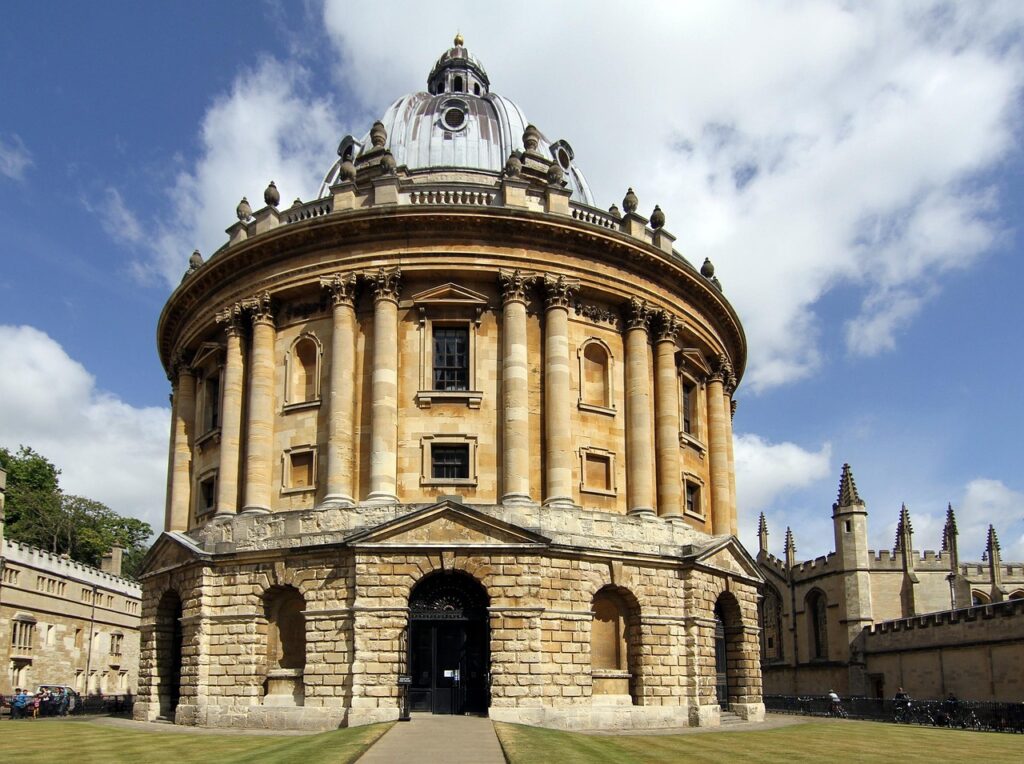
Oxford’s university isn’t tucked away on a single campus. Its colleges, libraries and halls are scattered throughout the centre, so simply walking around the city brings you face to face with centuries of academic history.
The Radcliffe Camera is perhaps Oxford’s most recognisable building, standing at the heart of the historic university quarter. Nearby are the Bodleian Old Library, the Bridge of Sighs and colleges including All Souls and Brasenose.
The Radcliffe Camera remains a working library and can only be entered by members of the public as part of an official tour, something worth bearing in mind if seeing the interior is important to you.
The Bodleian Libraries visitor information is useful for checking tours and access before your visit.
Oxford also rewards travellers whose interests extend beyond the university. The Ashmolean Museum, founded in 1683, has collections spanning archaeology and art from ancient Egypt to the present day, and general admission is free. It easily ranks among England’s greatest museums.
Literary history is everywhere too. J.R.R. Tolkien taught at Oxford, while Lewis Carroll developed Alice’s Adventures in Wonderland during his years at Christ Church. Add the pubs, bookshops and medieval lanes, and Oxford has plenty to occupy visitors who aren’t particularly interested in university history.
With Bespoke England Tours, you can visit Oxford and Blenheim Palace on a single tour.
Why Visit Cambridge?
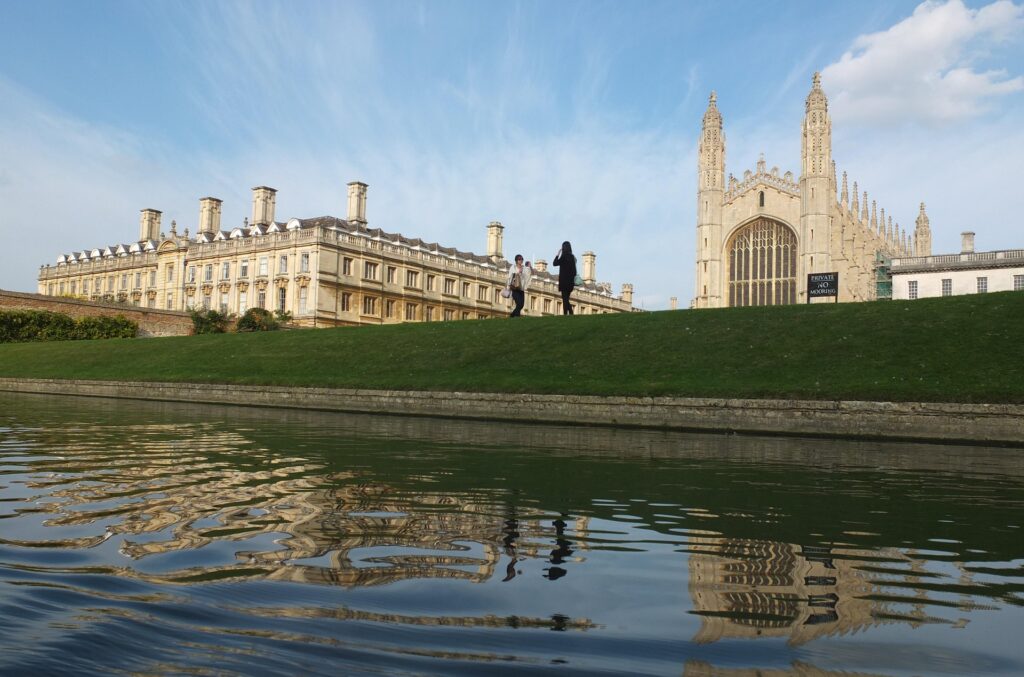
Cambridge offers many of the same pleasures – old colleges, chapels, libraries and distinguished former students – but the setting changes the experience.
The River Cam passes through the historic centre and alongside the College Backs. Taking a punt along the river provides views of landmarks including King’s College Chapel, Trinity College’s Wren Library and St John’s College’s Bridge of Sighs from the water.
It makes Cambridge particularly pleasant if you don’t want to spend an entire day walking from one historic building to another. You can wander through the centre, see several of the famous colleges and then sit back while someone else does the work on a chauffeured punt.
Visit Cambridge’s guide to punting for more information about the experience and licensed operators.
Cambridge also has an extraordinary scientific legacy, with names such as Isaac Newton, Charles Darwin and Stephen Hawking associated with the university. Art lovers have another reason to visit: the Fitzwilliam Museum houses collections ranging from ancient Egyptian objects to modern and contemporary art, with free general admission.
Which Has the Better Architecture?
Now, this is where choosing becomes difficult.
Oxford arguably offers greater variety. Gothic colleges sit alongside classical and Baroque buildings, and the university has grown within the city over many centuries. Walk around Radcliffe Square, Broad Street and the surrounding lanes, and there is almost always another tower, courtyard or carved doorway demanding your attention.
Cambridge has the advantage of setting. Its great college buildings open onto lawns and the river, particularly around the Backs. Seeing King’s College Chapel rising above the Cam from a punt is a very different experience from exploring Oxford’s denser streets.
Put simply: Oxford has the edge for architectural variety; Cambridge has the edge for scenery.

History, Literature or Science?
Literature lovers may find themselves drawn towards Oxford. Tolkien and Lewis Carroll are only two names in a remarkable literary tradition, and the Bodleian Libraries add considerably to the city’s bookish character. The Bodleian complex itself includes the Weston Library, Old Bodleian and Radcliffe Camera, with various tours available to visitors.
There’s also a film connection. Several Oxford locations will be familiar to fans of the Harry Potter films, making the city easy to combine with a broader Harry Potter-themed trip.
Cambridge, meanwhile, has an especially strong claim for anyone fascinated by science. Its roll call of scientists stretches across centuries, and the university remains inseparable from some of the biggest developments in physics, biology and mathematics.
There’s no strict dividing line, of course. Oxford has produced scientists, and Cambridge has produced writers. But as a visitor experience, Oxford tends to feel more literary and historical, while Cambridge wears its scientific heritage particularly proudly.
What About Punting?
Both cities have punting traditions, but Cambridge is the place where it becomes an attraction in its own right.
A trip along the Cam provides a perspective on the university that you simply cannot get from the street. The route along the College Backs passes some of Cambridge’s most famous buildings and bridges, making the journey part sightseeing tour and part chance to give your feet a rest.
If you’re travelling as a couple or family and want your day to include something besides walking tours, museums and historic interiors, this may tip the balance towards Cambridge.
Which Is Better for a First-Time Visitor?
If you want literary history, museums, imposing architecture and a city with plenty happening beyond the university, Oxford is probably the stronger choice.
If your ideal day involves beautiful college views, riverside scenery and a leisurely punt, Cambridge may suit you better.
Families might appreciate the change of pace offered by punting in Cambridge. Visitors with a strong interest in British history or literature may get more from Oxford. Couples looking for a relaxed day outside London could happily choose either, although Cambridge’s river setting certainly makes a persuasive case.
There really isn’t a wrong answer.
Fitting Oxford or Cambridge Into a Longer England Tour
You also don’t necessarily have to treat either city as an isolated day trip.
Oxford combines particularly well with other destinations west of London. Bespoke England Tours’ Oxford and Blenheim Palace Private Tour pairs a walking tour of Oxford with a visit to Blenheim Palace, the birthplace of Sir Winston Churchill. The tour is fully customisable and includes private transport from central London.
Oxford can also form part of a longer route through southern England. A journey from London through Oxford and the Cotswolds towards Bath, for example, allows the university city to become one chapter of the trip rather than an excursion requiring a return to London.
Cambridge works particularly well in itineraries heading north. Bespoke England Tours includes Cambridge within its longer private multi-day tours of Britain, including itineraries combining destinations across England and Wales.
And if you have particular places or interests in mind, a custom private tour of England allows the route and pace to be built around them.
Oxford or Cambridge: Which Should You Choose?
For history, literature, museums and architectural variety, we’d lean towards Oxford. For riverside scenery, punting and a slightly gentler university-city experience, Cambridge has the advantage.
But this isn’t really a contest that needs a winner. The two cities have developed distinct personalities despite the comparisons that have followed them for centuries.
If your itinerary allows it, visit both. If it doesn’t, choose based on what you actually enjoy rather than on which university happens to win the Boat Race.
